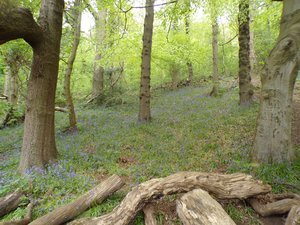
Our 2026 field trip season got underway as 14 attendees assembled for a late April day exploring Lancashire Wildlife Trust’s flagship Brockholes Nature Reserve. This former sand and gravel quarry, flanked by the river Ribble on the outskirts of Preston and under the shadow of the M6 motorway, presents a diverse mix of habitat including wetland and open water, sandy banks and scrapes, meadowland and hazel coppice and the adjoining ancient woodland of Boilton. Whilst the day remained dry for us, the sun only appeared intermittently – and most frustratingly as our field trip was coming to a close! – and chilly and breezy conditions meant that we weren’t able to enjoy the volume or variety of wildlife we were hoping for at this bounteous time of year, however keen eyes and local knowledge and expertise helped us to uncover some definite highlights during our visit.
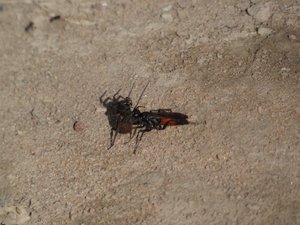
We started by examining the sandy banks along the path down to the visitor centre which are home to a range of mining bee species and their associated parasites. The chilly conditions meant activity was limited to a handful of Ashy Mining Bees and, later in the day, a Dark-Edged Bee Fly. However the most striking finding – and arguably the highlight of the day – was the sight of a Spider Wasp bearing its prey into safe storage. These insects hunt out spiders, particularly wolf spiders, which they paralyse with their sting and then store the arachnid in their nest burrow as living food for their larvae. Although these distinctive insects, with a red tip to their otherwise black abdomen, can frequently be seen as they actively hunt on the ground, this was only the second time I had ever seen one with its prey – the first occasion having been just four days earlier at Gait Barrows!
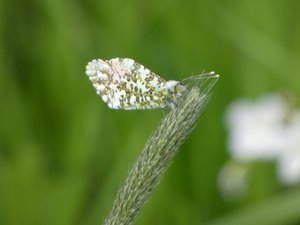
We moved onto the riverside meadows where the chilly conditions enabled us to get closer views of torpid invertebrates including some Orange Tip butterflies on their Cuckooflower food plants. We also saw Early Mining Bees, Alder Leaf Beetles and several of the distinctive larvae of the Timothy Tortrix moth. In one of the largest hazel coppices there is an extensive carpet of the unusual Moschatel, better known as the Town Hall Clock. The plant’s curious appearance is matched by its curious common name, which is derived from the Latin word for ‘musk’ which is apparently similar to the smell of the flowers. Even less complimentary is the genus name ‘Adoxa’ which is a combination of Ancient Greek and Latin and which can be translated as ‘without glory or splendour’, a harsh assessment of this under-stated plant, although this particularly crop were admittedly some way past their best.
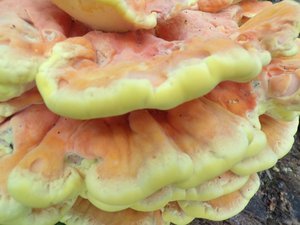
We paused briefly to enjoy the spectacle of Common Terns fishing on the Ribble before heading into Boilton Wood. This ancient broadleaved woodland is renowned for its springtime display of Bluebells although again these were starting to show signs of going past their peak. This was still a fine spectacle though, accompanied by much less conspicuous quantities of Arum, Wood Sorrel and Wild Garlic. The most striking find in this area was a burgeoning crop of pristine Chicken of the Woods fungus with one substantial fruiting body having freshly-emerged from the trunk of a fallen tree and other specimens just starting to emerge. The fungi gets its common name from the texture of its flesh rather than the taste and it isn’t necessarily top of the fungi foragers’ list of prized finds – it is also the favoured foodstuff of the Hairy Fungus Beetle.
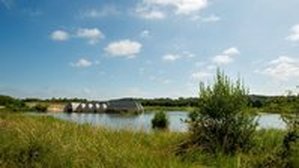
After pausing for lunch we resumed with a shorter walk along the entrance road, providing views over the main Meadow Lake and then returning along the cycle path with views over the flooded gravel pit. As the sun intermittently promised to make an appearance a few more invertebrates were added to the list with four Red and Black Froghoppers seen near the visitor centre car park. The main highlights along this stretch were from the reserve’s larger fauna though with my first Swifts of the year seen hawking over the lakes in a large company, alongside the resident Sand Martins which we had observed visiting their nesting burrows along the riverbank and in the artificial bank on the shores of the gravel pit. Using the Merlin birdsong app allowed us to add Garden Warbler to the list alongside the other warbler species we had heard but infrequently seen throughout the day whilst our last sighting of the day was of a female Roe venturing from cover on a spit of land in the middle of Meadow Lake.