
Sixteen people gathered on a very hot, sunny day and were glad of a light, cooling breeze blowing off the sea. The meeting was organised by Linda Renshaw to coincide with a suitably low tide, exposing an expanse of shallow rock-pools.
Armed with pots and hand-nets, the group worked our way slowly across the area searching under rocks and seaweed and in sandy pools. Slimy green seaweeds dominated many of the shallow pools and Linda showed us the wide green fronds of the aptly-named Sea Lettuce (Ulva Lactuca) amongst the green, entrail-like Enteromorpha. Both are especially common where freshwater runs into the sea.
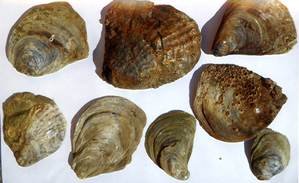
On the rocks were mats of brown seaweeds, including Bladder Wrack (Fucus vesiculosus) and abundant acorn barnacles. Attached to the underside of some rocks were the white irregularly-twisting tubes of the Keel-worm (Pomatoceros triqueter), and numerous Common Periwinkles (Littorina littorea). Linda also managed to find a Chiton (Lepidochitona cinereus) attached to the underside of a rock. These unusual molluscs have shells divided into segments – hence their alternative name of Coat-of-Mail Shells. Also on the rocks were numerous Beadlet Anemones (Actinia equina), mostly with their tentacles retracted, but Linda found us one expanded in a pool. Sticking up about 3 cm out of the sand were sand-encrusted tubes of Tube-worms. It was also interesting to find a number of Oyster (Ostrea edulis) shells under stones.
All of the sandy pools had good numbers of Common Prawns (Palaemon serratus) and Brown Shrimp (Crangon crangon) of all sizes, with some larger prawns being ‘berried’ – meaning that they were carrying clusters of dark-coloured eggs under their abdomens. Shore Crabs (Carcinus maenas) were abundant amongst the Bladder Wrack and under stones, including a few large examples.
The fishes were easy to see, but difficult to catch, although Linda is adept at this. Most were Common Gobies (Pomaloschistus microps), with an occasional Shanny/Common Blenny (Lipophrys pholis). Linda also found a nice Moon Jellyfish (Aurelia aurita), although it was stranded and possibly dead.
Altogether a very enjoyable chance to have a close look at what can be found in our local rock-pools in glorious weather. Throughout the meeting we could also observe numbers of Red Admiral Butterflies migrating along the beach and flocks of Oystercatchers and Redshank could be heard calling from nearby sand-banks.
Steve Garland